Plenty of investors have made a fortune within just 1 to 2 months — some even seeing their social standing change entirely after entering this 4.0 financial market.
Yet no small number of investors (even large funds) in this market have suffered, and continue to suffer, enormous pain.
The following story from the investment fund Three Arrows Capital is a classic example of this issue.
What is Three Arrows Capital? Why did such a famous name in tech investing go bankrupt?
First, let’s learn more about Three Arrows Capital with The Fool!
Three Arrows Capital was founded in 2012 by Zhu Su and Kyle Davies, headquartered in Singapore, known for a string of high-value investments in digital assets.
Last year, Zhu Su once predicted: “The world’s largest digital currency could reach 2.5 million USD per coin.” But by May of this year, as the crypto market started to slump, Zhu admitted on Twitter that his thesis had “unfortunately been wrong.” (According to VNExpress.)
So why did such a large, reputable fund like Three Arrows Capital suddenly stumble in the crypto market?
The story began on June 14th, when Zhu Su — CEO and co-founder of Three Arrows Capital — unexpectedly deleted his Instagram account and went silent on Twitter, sparking rumors that 3AC had defaulted.
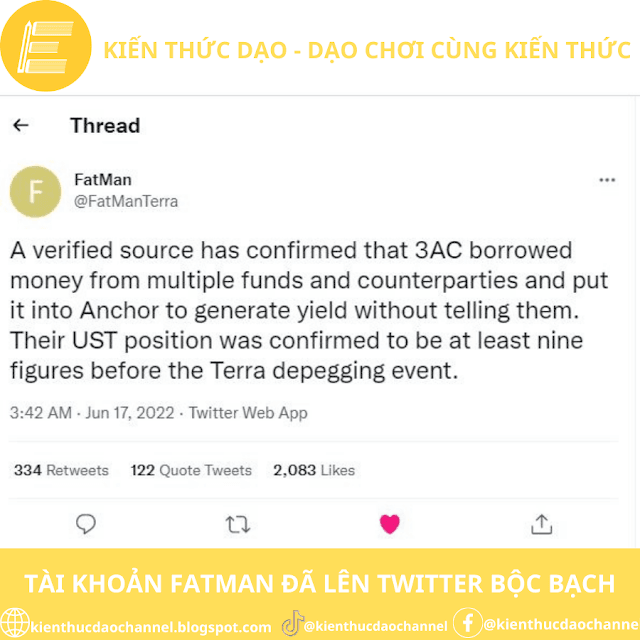
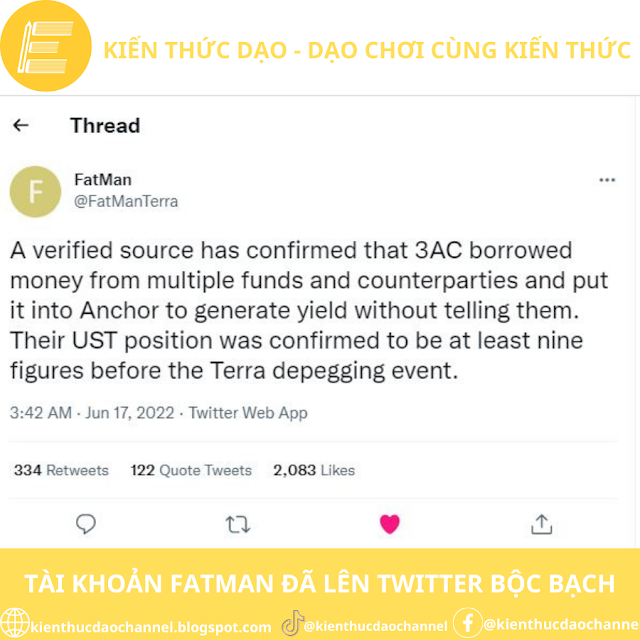
According to crypto experts and major Twitter accounts in the market, the sharp dump of LUNA-UST wiped out over 600 million USD from Three Arrows Capital’s account. What’s more, this fund had reportedly deceived a number of other investors and large funds by…
A well-known #crypto account, Fatman, shared his take.
Beyond just losing on the Luna gamble, this fund’s collapse — despite an 18-billion-USD valuation — also came from ineffective use of financial leverage. This began when 3AC took an ETH (Ethereum) loan from this finance company, using it as collateral at another…
Eventually, the inevitable happened: digital-asset brokerage Voyager Digital recently announced that Three Arrows Capital was unable to repay a loan of 350 million USD in USDC stablecoin and 15,250 Bitcoin, worth around 323 million…
The CryptoWhale account reported on the relationship between 3AC and Voyager Digital.
Lessons for investors in the #crypto market specifically, and finance in general, from Three Arrows Capital’s story
.png "THREE ARROWS CAPITAL AND 3 LESSONS ON USING LEVERAGE IN FINANCIAL INVESTING 3")
1. Don’t stack leverage on top of leverage
Financial leverage is an effective tool that helps investors own more of a financial asset — stocks, forex, crypto, etc. — with far less capital than their actual value.
A simple example of using financial leverage: you have 100 million VND, and stock A is listed at 100,000 VND a share. In this case:
- Without borrowing from a securities company, you can only own 1,000 shares of company A with your current money (excluding transaction fees, tax, etc.).
- If you use those 1,000 shares as collateral to borrow another 100 million VND from the securities company, you now owe the company 100 million VND and own 2,000 shares of company A.
Borrowing money from a securities company to own more shares is applying financial leverage (in finance circles, this is called margin borrowing).
Typically, each securities company has its own list of which stocks are eligible for margin, and at what ratio for each specific stock. However, the margin ratio isn’t usually too high, and rarely reaches 10 times your account.
The #crypto market is the opposite — coins can multiply many times over in a short period. That means the margin ratio offered to investors tends to be much higher (sometimes up to 50x or 100x, depending on the exchange).
Three Arrows Capital’s story — stacking leverage on leverage
After losing 600 million USD, 3AC apparently still didn’t learn its lesson. Instead, they kept investing under an “all or nothing” strategy, continuously applying leverage across multiple lending platforms and other #crypto funds like BlockFi, FTX, Deribit, and BitM…
This led to a situation where, once the #crypto market turned chaotic and dropped sharply, Bitcoin lost over 70% of its value.
The same thing happened with Ethereum — the coin 3AC held and used margin on the most. Because of this, the big players who’d lent to 3AC were forced to simultaneously close their positions and demand 3AC settle its margin loans.
Stacking leverage on top of leverage had a massive impact on Three Arrows Capital’s trading account.
2. You must have an effective capital-preservation strategy
Margin is a double-edged sword — so when using it, an investor needs to precisely calculate their capital, how much they’ll have left after taking on margin, and the margin interest, in order to have a fitting capital-preservation plan.
- For the stock market
Example: at HSC securities, the average margin interest rate is 0.04%/day, working out to roughly 14.5% over 12 months. That’s a fairly high rate (double a bank savings deposit).
So suppose an investor doubles their account (a 100% margin lending ratio — extremely rare and almost nonexistent) by borrowing 100 million VND, bringing their total capital to 200 million as above, and then loses 15%. They’d have to:
— Pay the securities company 14.5 million in interest. — Pay back the 15%/year loss, equivalent to 30 million. — Repay the securities company the 100-million-VND loan principal. => Lose a total of about 44.5 million VND/year.
However, suppose you achieve a 15% gain after 1 year instead:
— That gain gets doubled, equivalent to earning 30 million on your capital for the year (your own capital plus the margin loan). — Repay the securities company the 100-million loan principal. — Pay the securities company 14.5 million in interest. => You’d net a profit of 15.5 million.
So if an investor estimates they can achieve at least a 15%/year return without margin (100 million earning 15 million), they can confidently use margin to boost their profit. This is also the most effective capital-preservation strategy in this market.
- For the #crypto market
The story is similar with crypto exchanges — say you take margin at a similar 14.5%/year interest rate and get a 20x account (put in 100 million, receive 2 billion). With that 100 million, you’d have to pay 175.5 million a year in interest to that crypto exchange.
This leads to a very high risk of blowing up your account, since the interest alone now exceeds your original capital — not to mention it’s entirely normal for a coin to suddenly drop by 2, 3, or 4 times its value.
So for the crypto market, the safest capital-preservation strategy is “you’re not allowed to lose.”
However, suppose you achieve a 15%/year gain — your profit also gets multiplied 20x, to 300 million; in this case you’d only pay 175.5 million in interest to the crypto exchange and still net a profit of up to 124.5 million VND.
Three Arrows Capital’s story — no capital-preservation strategy, leading to massive losses
As the math above shows, with just a 20x margin, an investor’s risk of blowing up their account is already very high. In Three Arrows Capital’s case, they took margin from multiple different companies (assuming each company gave them 20x margin as calculated above, it would only take 2 companies calling their margin for them…
Worse still, unlike stocks, a coin’s price can suddenly lose over 70% of its value within just a few minutes — which made it hard for 3AC’s leadership to react in time, sinking deeper and deeper into debt, until they were finally forced to file for bankruptcy.
Three Arrows Capital’s bankruptcy was the result of failing to set aside a reserve fund and lacking an effective capital-preservation strategy.
3. Don’t FOMO too hard into news or someone else’s personal opinion
Investing always comes bundled with some degree of risk. But if we — investors — don’t arm ourselves with a solid foundation of knowledge, it becomes very easy to get swept up by someone else’s temptation, get manipulated, and end up losing money.
See also: What Is the FOMO Effect (Fear Of Missing Out)?
The FOMO phenomenon is a very common tactic used by stock “chicken-herding” groups to make investors feel like they’ve missed out on a lucrative opportunity. The case of FLC-family stocks and the recent arrest of Mr. Trịnh Văn Quyết is a classic example. Before the Trịnh Văn Quy…

A post from the admin of the Anti Stock-Herding Group told the story of Trịnh Văn Quyết.
Three Arrows Capital’s story — swept up in Luna’s downward spiral.
The root cause of the bankruptcy lies in 3AC losing 600 million USD after Luna collapsed and Do Kwon was left with nothing.
Anonymous’s recent warning to Do Kwon, and Luna’s price shooting straight up the very next day afterward, somewhat reveals the scam project he’d built to FOMO investors into it.
3AC wasn’t the only one — a number of investors in the Vietnamese market also got swept up in that phantom Luna project at times and lost a great deal of money.