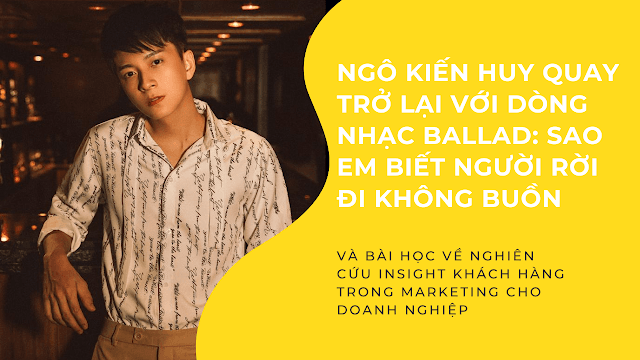
These past few days, anyone who’s been a fan of “Bắp” (Ngô Kiến Huy) since 2008 has felt excited to follow this singer’s new music video.
Living up to fans’ expectations, the MV, released right around Christmas, gave audiences a genuinely “Bắp” feeling reminiscent of his early days — a version untouched by trends, quite different from his previous, more entertainment-focused MV.
So how did Bắp’s team apply an inbound marketing strategy to win fans over? Let’s go through the lesson on researching customer insight, applied to this singer’s career, with The Fool!
1. Ngô Kiến Huy’s potential customer insight
Let’s go over some information about Ngô Kiến Huy’s potential customer insight (his fans) with The Fool!
- Age:
Ngô Kiến Huy became famous starting around 2008. According to a study by UK online music platform Deezer, 60% of survey respondents said the music they listened to between ages 12-16 heavily shapes their listening habits later in life.
=> So most of Ngô Kiến Huy’s fans belong to the middle-to-late Gen Y generation (born 1993-1996).
- Life experience and customer behavior:
- On entertainment
— They lived through the golden age marking the growth of entertainment in general, and music in particular (often called the “2k era” — the 2000s to around 2012), when the influence of major entertainment industries like Korea, Taiwan, and the US/UK strongly shaped Vietnam’s…
=> Genres like R&B and Pop-Ballad flourished during this time, with a wave of rising stars like Đông Nhi, Bảo Thy, and Ngô Kiến Huy himself. Several gameshows from these countries also started being embraced in Vietnam (setting the stage for later remakes).
— They also lived through the era when hip hop culture first took root in Vietnam and grew into what it is today (2005 to now), through the game Audition and a handful of underground rappers at the time, like Wowy, Karik, Nah, and, in the North, LK, Lil Shady, and others.
=> An old-school rap community formed, and singers collaborating with rappers on a single music product became popular.
- On technology
— They lived through an era when new technology was just beginning to develop, with few online platforms for listening to music. Back then, it was common to see young guys skip class to go to an internet café, a sign that a home PC and internet access were still fairly expensive.
=> TVs and disc players remained the main way to enjoy entertainment, with young people often buying their idol’s VCDs and DVDs to listen to; alongside that, the growth of cable TV helped diversify young people’s entertainment channels at the time.
=> Because access to music was fairly difficult, combined with less advanced audio technology, each singer’s voice tended to stick deeply with fans (sometimes you could recognize which singer was performing just by ear, without even looking).
2. How did Ngô Kiến Huy make use of this customer insight?
- Fully leveraging the gameshows his potential customers (his fans) tended to watch
As mentioned above, during the 2k era — the 2000s through around 2012 — gameshows from Korea started making their way into Vietnam and created a huge splash on the Vietnamese entertainment scene.
From there, a new entertainment era opened up (the 2010s), with more and more gameshows remade from Korean versions appearing on TV channels.
At this point, music also gradually shifted to a more modern sound with more electronic elements (genres like EDM, Trap, and growing autotune technology), which no longer fit these older stars, as artists like Sơn Tùng M-TP and a new wave of young singers rose to the top.
=> Vietnamese artists who’d become famous in the 2k era had to find themselves a new direction, or pick up some kind of business venture.

Ngô Kiến Huy chose the path of becoming an MC, joining TV gameshows remade from Korean versions like Hidden Singer and Running Man. You could say this was a smart choice that kept his name alive in the hearts of…
Building on his fans’ habit of watching TV and their love of Korean-style gameshows, Ngô Kiến Huy held onto his fans’ affection for a long stretch of time.
- Using a decoy effect before releasing what would become his signature ballad
Before releasing “Sao Em Biết Người Rời Đi Không Buồn,” Ngô Kiến Huy released a TikTok-trend-riding song, which received no shortage of mixed opinions from his own fans.
Fans felt that MV, while nice-looking and on-trend, didn’t showcase his vocals fully and came across as a bit over the top and gimmicky.

Mixed opinions on Ngô Kiến Huy’s TikTok channel about that earlier trend-riding song.
However, that earlier song served as a decoy product to draw every eye toward Ngô Kiến Huy (he even deliberately invited the hot celebrity cast of “2 Ngày 1 Đêm” to appear in it, to generate even more buzz for that MV).
Then, just a month later, our Bắp released what’s considered his real strength: a new ballad that appeared right around Christmas — “Sao Em Biết Người Rời Đi Không Buồn.”
This decoy effect worked brilliantly, with a wave of positive comments coming in right after, telling Bắp to keep this style forever.
Unlike his earlier trend-riding song, this new ballad, though on the same channel, received completely opposite comments.

The contrasting decoy effect from that earlier song created a notable highlight that helped “Sao Em Biết Người Rời Đi Không Buồn” become a resounding success. To pull this off, Bắp’s team had to very carefully analyze the social-media behavior of his own potential customer base…
- Using the right KOL/KOC to preview the product before release
On using KOLs/KOCs, The Fool has already covered a failed case from the FIFA World Cup organizers, who chose Jung Kook as their face for the event.
Back to “Sao Em Biết Người Rời Đi Không Buồn,” Ngô Kiến Huy’s team did an excellent job choosing preview artists from his own generation, like Phạm Quỳnh Anh, Trương Quỳnh Anh, and Thu Thủy, to talk about this song.
This choice was smart, because the people picked to preview it were also once idols of the ballad genre themselves, with plenty of experience conveying and describing the emotions of a song authentically to audiences (it’s literally their job, after all).
Choosing idols beloved by the 2k-era young generation to preview the product was a smart move by Ngô Kiến Huy’s team.

Inviting people who were once idols of the very audience he wanted to target helped add even more pull to the song, since a large number of people who weren’t his loyal fans, but still loved the genre he pursued, ended up listening to this song too. Had it gone the other way, Ngô…
3. Conclusion: the practical lesson on researching customer insight for businesses
Researching customers in marketing works the same way — if you grasp your potential customer’s habits and preferences, your brand image will stay in your customer’s heart forever.
In marketing, if you apply a decoy product effectively (not necessarily a good product itself — see the iPhone 8 and iPhone X case study) based on thoroughly researching customer behavior, you can create an extremely powerful boost for the actual product you want to promote.
In marketing, if we can bring on KOLs/KOCs who are genuinely respected in the field we work in to preview or review our products and services, the results we get back will be far greater than inviting famous people who have nothing to do with our product or service.
THE FOOL — EASY KNOWLEDGE CHANNEL