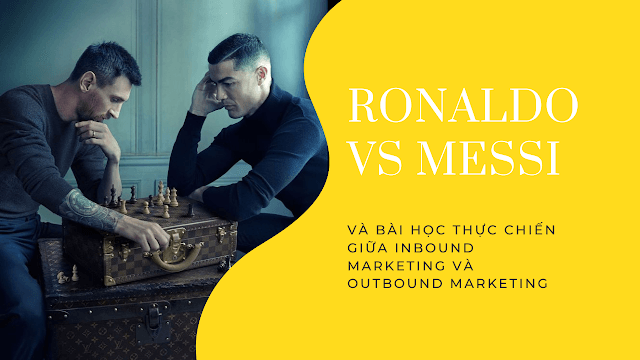
Throughout the recent 2022 World Cup campaign, the rivalry between the two players dubbed the GOAT (Greatest Of All Time) of modern football has always been a hot topic among the press.
So far, the result is still undecided, but the GOAT title has leaned somewhat toward Messi, who needed just one more match to reach the goal both men have chased their entire careers — the World Cup trophy.
So why has Messi come out somewhat ahead of Ronaldo, and what real-world lesson does this tell us about Inbound and Outbound marketing? Let’s find out with The Fool!
First, let’s revisit Inbound marketing and Outbound marketing with The Fool
As The Fool mentioned in the article “COVID-19 — An Opportunity to Apply Inbound Marketing for SMEs”:
Inbound marketing is a marketing approach aimed at creating useful value for users, bringing customers the most helpful value and encouraging them to engage with the business. From there, the business uses specific tactics to reach out, nurture, and increase the conversion rate of these customers.
In contrast to Inbound marketing, Outbound marketing, put simply, is an approach where a business “forces” customers to receive the content it provides. Information is sent out broadly, without any targeting.
So how does Inbound marketing relate to Messi’s playing style and PR approach?
How Inbound marketing relates to Messi’s playing style

From Messi’s casual walk to the plays that go down in history.
We all notice that for most of the time on the pitch, Messi simply walks around, observing the game and looking for gaps in the opposing defense — then he strikes those exact gaps with devastating plays, ultimately taking down the opponent with a few signature dribbles and bursts of speed.
This is somewhat similar to a typical Inbound marketing strategy, which applies customer-insight analysis techniques — Messi studies his opponent’s weaknesses in great detail before deciding to accelerate and take out a string of defenders.
How Messi handles PR
The way an Inbound marketing strategy handles PR is usually based on a company’s internal strengths — using content, ebooks, emails, etc., to precisely target customers’ need for information about the products and services a business or shop provides.
Going back to how Messi handles PR: throughout his career, Messi has rarely appeared in the media. Moreover, whatever the media does say about him tends to be based on his own inherent ability, which has created an almost “perfect” image of this player in fans’ eyes.
Doing PR based on your own inherent strengths has given football fans in general, and Messi’s fans in particular, a stronger impression of him — while also putting far less pressure on him when he plays on the pitch.
The same goes for a business’s PR process: if we build quality content based on our company or shop’s genuine internal value, our image in potential customers’ eyes will be far better.
On the flip side, how does Outbound marketing relate to Ronaldo’s playing style and PR approach?
How Outbound marketing relates to Ronaldo’s playing style

From a fiery Ronaldo to wearing out the bench.
Unlike Messi’s style, Ronaldo’s game relies far more on physical effort — constantly making runs to drag defenders around, jumping high for headers (once considered his single strongest skill). This appeared simple and effective for him back when he was in peak physical form.
This is similar to applying an Outbound marketing strategy for a business — when a business doesn’t rely on its internal value, but instead focuses heavily on PR channels that “force” consumers to remember its products and services, such as press coverage, TVCs, etc. This can bring success, but…
Moreover, in today’s economic downturn, pouring too much budget into the above media channels can easily push a business into a precarious position.
How Ronaldo handles PR

The conversation between Ronaldo and Piers Morgan sparked all the difficulties he faced on the pitch.
Before the World Cup campaign in Qatar, Ronaldo sat down with journalist Piers Morgan to talk about what he’d been through and his feelings about the very club he was playing for — Manchester United.
In that interview, Ronaldo inadvertently said some unflattering things about the club and claimed he felt betrayed by it. This pushed his name onto thousands of headlines, and even before setting foot on the World Cup pitch, he was already outshining Messi in terms of media coverage.
However, speaking out with such criticism turned out to be a double-edged sword:
- To MU fans, he now looked like a traitor, and they grew somewhat less fond of him.
- To his teammate at MU, Bruno Fernandes, this also caused resentment — Bruno could no longer speak up in his defense or coordinate with him as well as before.
These two factors contributed to mounting pressure on Ronaldo’s shoulders ahead of the World Cup. In the end, although he scored one goal for Portugal in this campaign, his tactical contribution was unclear.
As a result, he was soon benched by the coach in the round of 16 and the quarter-final against Morocco — and as everyone knows, it was Morocco that eliminated Portugal from this World Cup.
Ronaldo’s actions mirror how businesses run Outbound marketing strategies for themselves — deliberately pushing loud PR across major media channels while forgetting their own identity, as well as the behavior of the potential customers they hope to win over.
Conclusion: the real-world lesson between Inbound and Outbound marketing for businesses
At a time before any economic crisis hits, a business can fully combine both Inbound and Outbound marketing for its own products and services, in a few ways:
- Book press PR articles (outbound) on channels frequented by potential customers, to support an SEO campaign (inbound) around the values your product brings to consumers, or the keywords potential customers tend to search for your product.
- Send out brochures (outbound) with QR codes leading customers to a detailed landing page about product information, features, and accompanying offers, supporting that product’s keyword to rank higher (inbound).
- Send mass emails (outbound) to potential customers about an ebook covering values related to your products and services (for example, an investment ebook for a finance company) (inbound).
However, given today’s tense economic downturn, businesses should limit spending on outbound channels that don’t fit, using measurable plans to track the results these channels bring in.
THE FOOL — EASY KNOWLEDGE CHANNEL