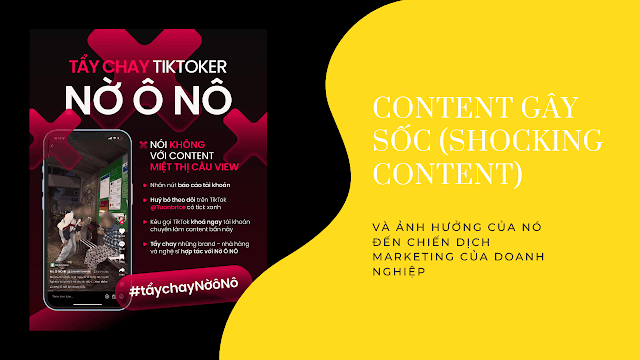
“Hello, lonely old lady in the middle of the cold winter.” That shocking line, trending online these past few days, has made us think a lot about the type of content this TikToker is pursuing.
Is this a nonsensical, off-putting type of content, or does it actually contribute something to a business’s marketing strategy? Let’s explore this with The Fool!
First, let’s understand the concept of “shocking content” with The Fool
Shocking content is a type of content that creates a surprise for the reader, aiming to grab attention and drive engagement (usually through irrelevant content, deliberately provocative titles, or a dramatic “twist”).
Common types of shocking content
- Posts (campaigns) with a positively shocking title
These are titles designed to surprise users, often used by brands or businesses to educate the market on some social issue.
This type of content usually opens with a “shocking title” that plays on the consumer’s sense of loss, when they do something harmful or overlook something in life — something the brand’s product or service usually addresses.
- Omo’s “Dirt Is Good” campaign

Omo’s “Dirt Is Good” campaign used a shocking title.
At first glance, this campaign’s title seems paradoxical to the point of being hard to believe, and could shock Omo’s own consumers — since their product is, after all, laundry detergent, yet the title contradicts what their product actually delivers to consumers.
However, if you think it through carefully and grasp Omo’s customer insight, you get a very different view of this brand’s positioning in consumers’ eyes:
- Most of Omo’s consumers are urban mothers, worried their kids might get “too dirty” playing outside amid dust and mud.
- On the flip side, if their kids stay home and never go outside to play, they’d end up glued to harmful electronic devices, unable to freely develop through real-life experiences.
Grasping these crucial insights, the brand confidently used the shocking title “Dirt Is Good” for its campaign — helping Omo solve two huge problems at once:
- Educating parents to let their kids go outside and play more.
- Highlighting their own product’s excellent stain-removing power (whatever the mess, Omo’s got you covered).
See more about the “Dirt Is Good” campaign here.
Building on that campaign’s success, Omo went on to release other campaigns like “Do Good This Tết, Don’t Fear Getting Dirty,” encouraging users to actively plant trees to protect the environment, carrying the same core message.
- Posts (campaigns) with a negatively shocking title
This type of content is often what many call “tabloid” content, used to attract viewers in order to earn ad-break revenue from online platforms like Google and Facebook.
The content itself usually offers nothing new (pulled from mainstream news sources, then edited and spliced together to steer public opinion around some shocking phenomenon).
However, the special trait of this content usually lies in a title designed to spark curiosity. That’s why these posts are commonly nicknamed “clickbait.”
.png "SHOCKING CONTENT AND ITS IMPACT ON A BUSINESS'S MARKETING CAMPAIGN 3")
A post with a negatively shocking title tends to grab a viewer’s attention and make them want to click through immediately (used to drive traffic to a website).
- Positively shocking images
Similar to a shocking title, a shocking image is a type of content that grabs viewers through pictures that create a certain surprise or interest.
These images make viewers curious about the product as well as any promotion (if there is one) from the business, immediately sparking an intent to learn more about and use that product.
- Frontline flea/tick medicine’s campaign at a large mall
.png "SHOCKING CONTENT AND ITS IMPACT ON A BUSINESS'S MARKETING CAMPAIGN 4")
Frontline’s flea/tick medicine campaign at a large mall used a shocking image.
Looking at the image above from a high floor, we can see this flea/tick medicine brand’s cleverness in borrowing the visual of a stream of people walking in and out of the mall, likening it to fleas crawling all over your dog.
The brand calculated this very carefully, pairing it with the clever tagline “Get them off your dog.”
With just this one smart, shocking move, the brand successfully drew in its target customers by:
- Thoroughly researching its customer insight — people who typically keep pets at home and often visit the mall’s upper floors for entertainment, dining, or movies.
- Or the brand may have carefully researched displaying their product on a high floor of the mall where they could easily look down.
- Negatively shocking images
Like a negatively shocking title, a negatively shocking image focuses on creating drama around celebrities, controversial events, or images that bring a bad influence to the community.
Images like this, paired with a negative title, help create a tabloid-style article that steers public opinion toward some controversial drama.
.png "SHOCKING CONTENT AND ITS IMPACT ON A BUSINESS'S MARKETING CAMPAIGN 5")
- Positively shocking videos
Similar to the two content types above, a positively shocking video is carefully calculated by brands as part of their content strategy, deliberately creating situations that feel frustrating but not offensive, or intentionally building in an unexpected twist in their video script.
- Hong Kong’s viral video “My Father Is a Liar”
Speaking of viral videos with an unexpected twist, we can’t skip Thailand and Hong Kong (pioneers of early viral social-media videos with massive reach), one example being Hong Kong’s “My Father Is a Liar” clip, or Thailand’s “The Deaf Father.”
- Aba detergent’s series of quirky videos

Aba detergent’s series of quirky videos.
Aba is no stranger to Vietnamese households. To this day, Aba detergent remains steadfast in its bland, seemingly nonsensical ad videos.
But hidden behind that is a very deliberate calculation in Aba’s shocking video series, after thoroughly researching their customer insight:
- Unlike Omo, Tide, or Ariel, Aba targets rural housewives (a cheaper, more down-to-earth segment centered around everyday life stories).
- Based on those insights, Aba created a wave of down-to-earth life videos (no high-end KOLs, no elaborate effects) with a rambling, mildly frustrating storytelling style.
- From those frustrating stories, customers grow curious about the product and start wanting to seek it out and own it.
- Most importantly, Aba’s tagline, “Spotlessly Clean,” sounds folksy and simple, and sinks deep into rural consumers’ minds, running through all their videos as a consistent strength.
Details on Aba’s video campaign here.
- Negatively shocking videos
The opposite of a positive video — like a shocking title or image, a negatively shocking video creates extremely heavy discomfort in viewers through excessive drama.
The most obvious recent example is a name that surfaced called “Nờ Ô Nô,” known for his extremely disrespectful charity clips toward elderly people living alone.
At this point, The Fool probably doesn’t need to say much more about the extremely strong boycott movement against his content on the TikTok platform (a platform whose audience is largely made up of minors and teenagers aged 16-22 or younger).
Conclusion on shocking content
Every form of negatively shocking content falls under what’s commonly called “trashy content.” Most people who use this type of content are trying to profit off platforms like Facebook and Google, or are KOLs trying to gain more fans on video platforms like YouTube and TikTok to make it easier to…
As a user and viewer on these platforms, we hope audiences can stay sharp enough to filter out genuinely necessary and valuable content. At the same time, don’t hesitate to report extremely negative shocking content like the example above. Alongside that, these platforms keep updating and changing their algorithms to help filter out this kind of…
As a brand, a restaurant, or a fashion shop owner, keep a level head to choose quality KOLs (whose content genuinely fits your field and who create clean content) to help elevate your brand instead.
THE FOOL — EASY KNOWLEDGE CHANNEL